
Status of Reporting and Response to Class 1 (New) Infectious Diseases
Definition of Class 1 Infectious Diseases
- Infectious diseases spread through bioterrorism or infectious diseases with a high mortality rate or a high risk of mass outbreak, requiring immediate reporting on the outbreak or epidemic thereof as well as high-level isolation, such as negative pressure isolation
Types of Class 1 Infectious Diseases
- Ebola virus disease, Marburg hemorrhagic fever, Lassa fever, Crimean-Congo hemorrhagic fever, South American hemorrhagic fever
- Smallpox, Pest, Anthrax, Botulism, Tularaemia
- Emerging infectious disease syndrome.
- Severe Acute Respiratory Syndrome (SARS), Middle East Respiratory Syndrome (MERS)
- Human Infection with Avian Influenza
- Novel influenza
- Diphtheria (under the jurisdiction of the Infectious Disease Control Division)
Class 1 Infectious Disease Response Guidelines
- Class 1 Infectious Disease Viral Hemorrhagic Fever Response Guidelines
- Class 1 Infectious Disease Response Guidelines for Smallpox, Pest, Anthrax, Botulism, and Tularemia
- Class 1 Infectious Disease Response Guidelines for Middle East Respiratory Syndrome (MERS) and Severe Acute Respiratory Syndrome (SARS)
- Class 1 Infectious Disease Response Guidelines for Human Infection with Avian Influenza
Class 1 Infectious Disease Reporting and Notification System
(Reporting and Notification Timing) Immediately
- The person obligated to report must submit the infectious disease occurrence or death (post-mortem examination) report, etc., to the head of the health center that has jurisdiction over the location of the infectious disease patient or the reporter using an information system or by fax.
- In the case of Class 1 infectious diseases, the obligor must inform the head of the relevant health center or the Commissioner of the Korea Disease Control and Prevention Agency verbally or by phone before submitting the report. Korea Disease Control and Prevention Agency Comprehensive Situation Room (043-719-7979) and Regional Disease Response Centers
- When a report is received by the Korea Disease Control and Prevention Agency (Comprehensive Situation Room), the Comprehensive Situation Room will immediately relay the relevant information to the pertinent regional disease response center (hereinafter referred to as the regional center), related departments of the Korea Disease Control and Prevention Agency, and local governments by phone. The provinces will coordinate with the relevant health centers to implement actions according to the response guidelines for each infectious disease.
(Scope of Reporting) Patients, suspected cases, carriers of pathogens
Applicable only to Middle East Respiratory Syndrome (MERS).
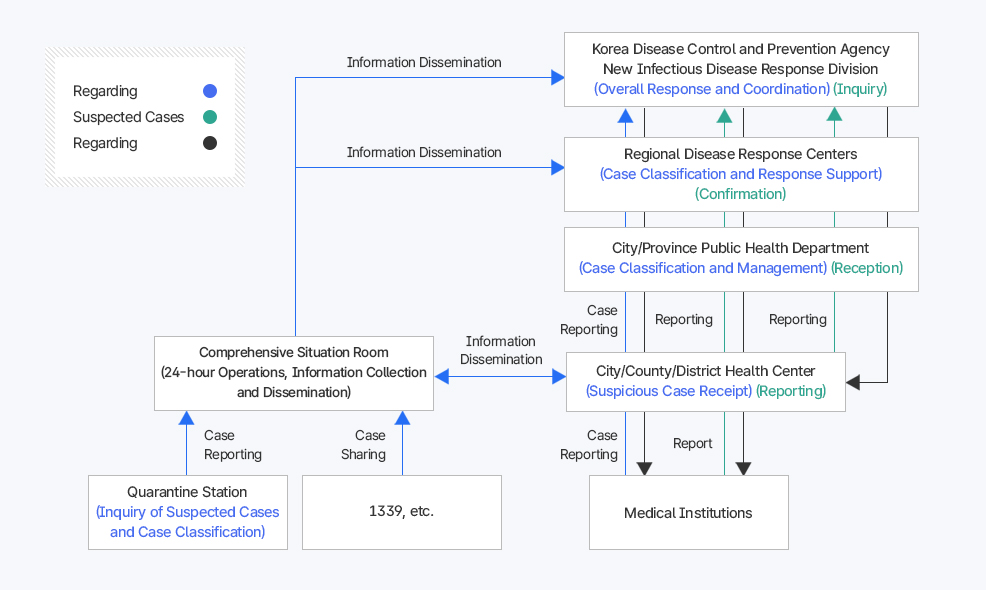
이 흐름도는 제1급 신종 감염병 발생 시 신고와 대응 과정을 나타낸다. 1. 사례 발생 및 보고 단계 - 검역소: 의심사례 조사 및 사례 분류 후 종합상황실에 보고한다. - 의료기관: 의심사례를 시·군·구 보건소에 신고한다. 2. 정보 수집 및 전파 - 종합상황실: 24시간 운영되며, 검역소로부터 사례 보고를 받고 ‘1339 콜센터’ 등 유관기관과 사례 정보를 공유한다. - 시·군·구 보건소: 의심사례 접수 후 상급 기관에 보고한다. 3. 상급 기관 보고 및 관리 - 시·도 보건과: 사례 분류 및 관리 업무를 담당하며, 권역별 질병대응센터와 질병관리청에 정보를 보고한다. - 권역별 질병대응센터: 사례 분류를 확인하고 대응을 지원한다. - 질병관리청 신종감염병대응과: 대응 총괄 및 조정 역할을 하며, 필요한 경우 직접 조회 및 관리한다. 4. 정보 환류 및 지원 - 각 단계에서 환류 및 지원이 병행되며, 최종적으로 사례 판정과 관리가 종합적으로 이루어진다. 색상 구분: - 파란색 선은 의심사례 관련, - 초록색 선은 감염병 환자 등 관련, - 검은색 선은 환류 및 지원을 의미한다.
Status of Class 1 Infectious Disease Reports in 2024
- Among the 722 suspected reports of Class 1 infectious diseases in 2024, a total of 97 cases (72 cases of MERS, 17 cases of AI human infection, 4 cases of tularemia, 2 cases of pest, and 1 case each of Lassa fever and botulism) were classified as suspected cases and underwent testing.
- No confirmed cases have been reported.
Status of Class 1 Infectious Disease Reports
| Target Infectious Diseases | 2020 | 2021 | 2022 | 2023 | 2024 | |||||
|---|---|---|---|---|---|---|---|---|---|---|
| Suspected | Confirmed | Suspected | Confirmed | Suspected | Confirmed | Suspected | Confirmed | Suspected | Confirmed | |
| Ebola virus disease | 1 | 0 | 1 | 0 | 5 | 0 | 2 | 0 | 0 | 0 |
| Marburg hemorrhagic fever | 0 | 0 | 0 | 0 | 0 | 0 | 0 | 0 | 0 | 0 |
| Lassa fever | 0 | 0 | 0 | 0 | 0 | 0 | 0 | 0 | 0 | 0 |
| Crimean-Congo hemorrhagic fever | 0 | 0 | 0 | 0 | 2 | 0 | 1 | 0 | 0 | 0 |
| South American hemorrhagic fever | 0 | 0 | 0 | 0 | 0 | 0 | 0 | 0 | 0 | 0 |
| Rift Valley fever | 0 | 0 | 0 | 0 | 0 | 0 | 0 | 0 | 0 | 0 |
| Smallpox | 0 | 0 | 0 | 0 | 0 | 0 | 0 | 0 | 0 | 0 |
| Pest | 0 | 0 | 0 | 0 | 0 | 0 | 0 | 0 | 0 | 0 |
| Anthrax | 0 | 0 | 0 | 0 | 0 | 0 | 0 | 0 | 0 | 0 |
| Botulism | 1 | 1 | 1 | 0 | 0 | 0 | 2 | 1 | 0 | 0 |
| Tularemia | 0 | 0 | 0 | 0 | 0 | 0 | 1 | 0 | 0 | 0 |
| Severe Acute Respiratory Syndrome (SARS) | 0 | 0 | 0 | 0 | 0 | 0 | 0 | 0 | 0 | 0 |
| Middle East Respiratory Syndrome (MERS) | 128 | 0 | 120 | 0 | 122 | 0 | 157 | 0 | 72 | 0 |
| Human infection with avian influenza | 6 | 0 | 2 | 0 | 5 | 0 | 5 | 0 | 17 | 0 |