컨텐츠 영역
National Laboratory System
Composition
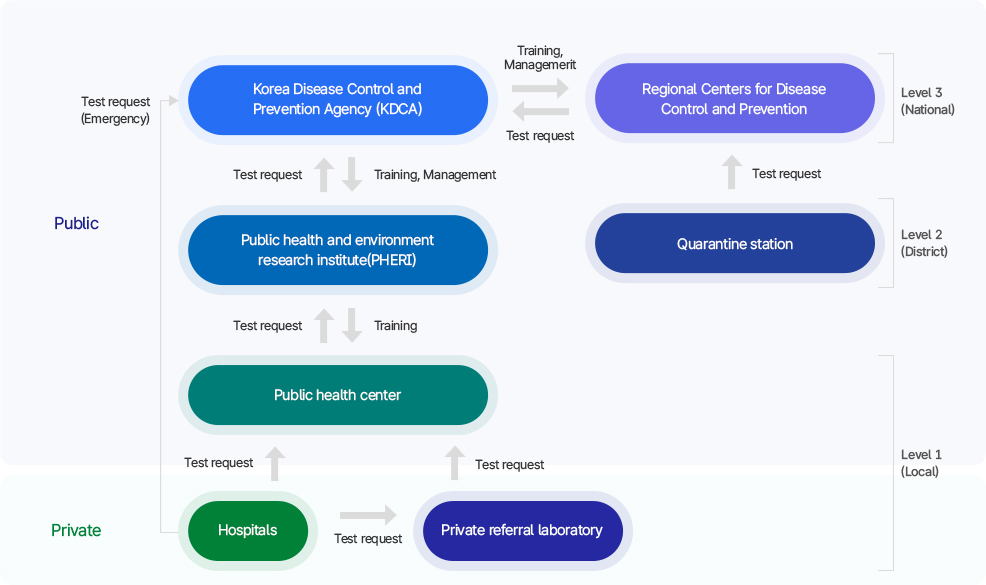
The national infectious disease diagnostic testing system establishes an organic cooperative system between public institutions* and private medical institutions** to ensure early detection of infectious diseases and prevent their spread * Korea Disease Control and Prevention Agency, Regional Disease Response Centers, 17 City and Provincial Health and Environment Research Institutes, Health Centers ** Hospitals, Clinics, Contract Testing Institutions
Role
Categories
- Left: Public sector
- Bottom-right: Private sector
- Levels:
- Level 1: Local
- Level 2: District
- Level 3: National
Public Sector (Top-down)
1. Korea Disease Control and Prevention Agency (KDCA, Level 3)
- Receives test requests, performs education and management.
- Coordinates with regional disease response centers (test requests, education, management).
2. Regional Disease Response Centers (Level 3)
- Cooperates with the KDCA and transmits test requests to quarantine stations when necessary.
3. Quarantine Stations (Level 2)
- Performs test requests at borders, ports, and airports, and reports to higher authorities.
4. Provincial and Metropolitan Health and Environmental Research Institutes (PHERI, Level 2)
- Handles test requests and performs educational functions.
5. Public Health Centers (Level 1)
- Receives test requests and reports at the community level.
Private Sector (Hospitals and Testing Centers, Level 1)
- Hospitals and testing centers (private referral laboratories) collaborate to handle test requests and check results.
- If necessary, test requests are transmitted to public health centers or higher authorities.
Emergency Situation
- Test requests may be directly transmitted to the KDCA in case of an emergency.
Summary Interpretation
The testing system is structured in levels: Local (Level 1) → District (Level 2) → National (Level 3).
The public (public health centers, research institutes, KDCA) and private sectors (hospitals, testing centers) cooperate to conduct infectious disease testing.
Roles of Each Institution
Korea Disease Control and Prevention Agency
Establishes national policies related to diagnostic testing for infectious diseases, manages and supervises the system, develops, verifies, and disseminates laboratory testing methods, and performs pathogen identification tests, analysis, and monitoring, fulfilling the role of a national reference laboratory
Disease Response Center
Performs diagnostic and analytical tasks for quarantinable infectious diseases within the jurisdiction and acts as a coordinator for testing.
City and Provincial Health and Environment Research Institutes
As public laboratories, conduct diagnostic testing for infectious diseases and pathogen surveillance within the jurisdiction in collaboration with private medical institutions.
Public Health Centers
Report outbreaks of infectious diseases reported by medical institutions, manage and supervise medical institutions, and conduct tests for certain infectious diseases.
-
Korea Disease Control and revention Agency
-
Development and establishment of national policies, plans, and standards for infectious disease laboratory testing
-
Management and supervision of the national laboratory system
-
Development, validation, and dissemination of laboratory testing and analytical methods for pathogens and vectors
-
Operate pathogen surveillance system for infectious diseases and vectors
-
-
Regional Centers for Disease Control and Prevention
-
Implementation of infectious disease laboratory testing and pathogen surveillance within region
-
-
Public health and environment research institute
-
Implementation of infectious disease laboratory testing and pathogen surveillance within province
-
-
Public health center
-
Reporting and management of prioty diseases
-
Conducting simple tests for infectious disease
-
Management and supervision of private medical institutions
-