컨텐츠 영역
Efforts are made to enhance the reliability of infectious disease diagnostic tests.
- Infectious disease diagnostic tests are the first step in epidemic response measures such as isolation and treatment, making accuracy essential..
- To this end, the Korea Disease Control and Prevention Agency is making various efforts to maintain and manage the diagnostic testing capabilities of public testing institutions for infectious diseases.
- Establishing Standard Operating Procedures (SOPs) for infectious disease laboratory testing methods
- Transferring verified standard testing method technology to local governments so that infectious disease diagnostic tests can be performed uniformly across the nation
- Conducting annual training and proficiency assessments on the transferred standard testing methods to manage testing accuracy
- Recognizing and managing laboratories with objectively proven capabilities in standard system operations as "National Standard Laboratories for Infectious Diseases" to promote the standardization of the infectious disease diagnostic testing system.
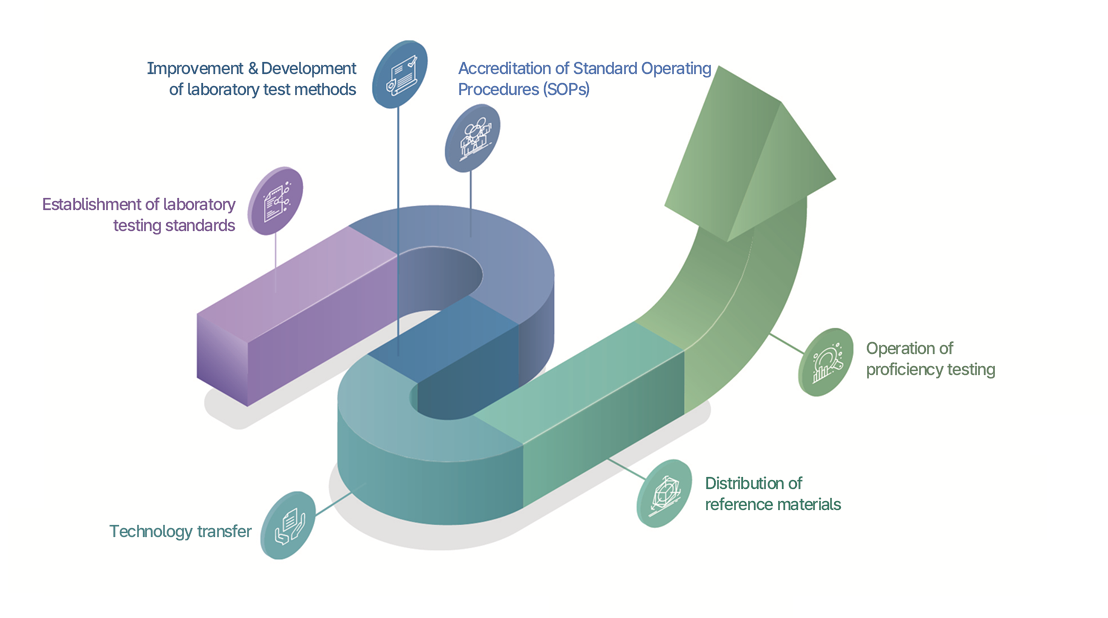
This image is a flowchart that represents the step-by-step process of diagnostic test quality management with curved arrows.
Starting Stage
- Establishing diagnostic test criteria: Setting test standards and guidelines.
- Test method development: Improvement and development of laboratory testing methods.
Intermediate Stage
- Standard Operating Procedures (SOPs) certification: Developing and certifying standard operating procedures for test performance.
- Technology transfer: Transferring developed technologies to relevant institutions or laboratories.
Advanced Stage
- Distribution of standard materials: Distributing reference standard materials to ensure the reliability of tests.
- Proficiency testing: Conducting proficiency assessments of testing agencies to maintain and improve quality.
Summary Interpretation
The entire process proceeds from establishing criteria → test method development → procedure certification → technology diffusion → standard material distribution → proficiency testing.
Ultimately, it represents a quality management system that ensures the reliability and accuracy of laboratory diagnostic tests.
Starting Stage
- Establishing diagnostic test criteria: Setting test standards and guidelines.
- Test method development: Improvement and development of laboratory testing methods.
Intermediate Stage
- Standard Operating Procedures (SOPs) certification: Developing and certifying standard operating procedures for test performance.
- Technology transfer: Transferring developed technologies to relevant institutions or laboratories.
Advanced Stage
- Distribution of standard materials: Distributing reference standard materials to ensure the reliability of tests.
- Proficiency testing: Conducting proficiency assessments of testing agencies to maintain and improve quality.
Summary Interpretation
The entire process proceeds from establishing criteria → test method development → procedure certification → technology diffusion → standard material distribution → proficiency testing.
Ultimately, it represents a quality management system that ensures the reliability and accuracy of laboratory diagnostic tests.
- 01
Provision of laboratory testing standards based on scientific evidence
- 02
Establishment of SOPs for laboratory testing through validation
- 03
Technology transfer through training and assessments of test methods
- 04
Operation of proficiency testing for accurate laboratory testing