컨텐츠 영역
COVID-19 Big Data (K-COV-N: KDCA COVID-19 NHIS COHORT)
Objective
COVID-19 Big Data (K-COV-N) safely combines domestic COVID-19 data and health data to support researchers and policymakers.
Main Content
- COVID-19 Big Data is currently being opened through the National Health Insurance Service’s big data open platform (nhiss.nhis.or.kr) since April 2022.
- When private researchers apply for access, the data is provided to them in the form of a customized research database after undergoing a data provision review by the Korea Disease Control and Prevention Agency and the National Health Insurance Service.
- Periodic presentations of research outcomes, such as big data utilization symposiums, are held to share research achievements with the public.
-

COVID-19 DatabaseConfirmed Cases Database- (date of confirmation, year of birth, gender, etc.)
- (date of vaccination, dose number, name of the vaccine, etc.)
-

National Health Insurance Service- Eligibility and premium information
- Medical treatment information
- Healthcare facility information
- Health examination information, etc.
COVID-19 confirmed cases (n=34,572,554)
2020. 1. 20.-2023.8. 31.
Infectious Disease Big Data Platform ( IDBP)
Objective
- To support the activation of infectious disease big data research and analysis, the main infectious disease data from the Korea Disease Control and Prevention Agency will be de-identified and made available to researchers, enabling utilization by researchers and policymakers.
Main Content
- Infectious disease big data is being made available through the Korea Disease Control and Prevention Agency's Infectious Disease Portal (https://dportal.kdca.go.kr starting from November 2024.
- When private researchers apply for access, data is provided to researchers after review by the Korea Disease Control and Prevention Agency's Data Provision Review Committee (excluding COVID-19 data).
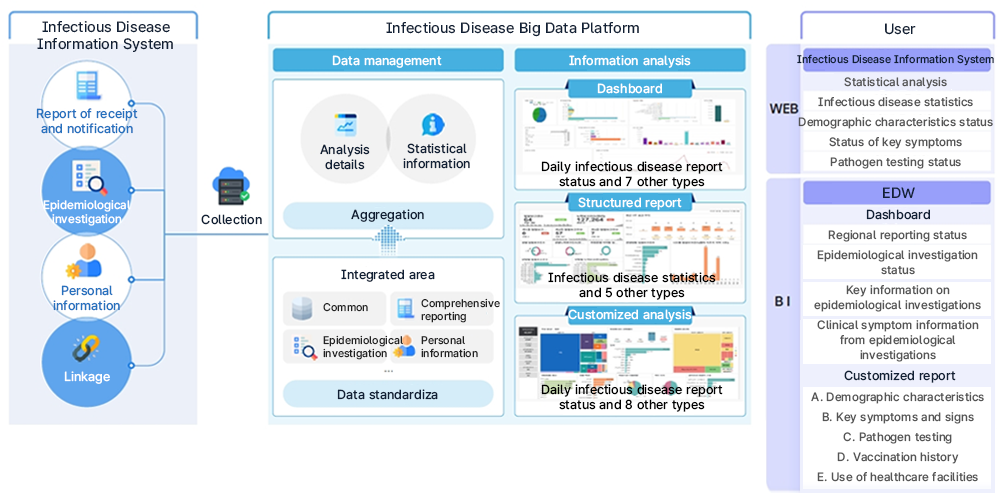
This diagram illustrates the process of data management and analysis by linking the Epidemic Control Integrated Information System and the Infectious Disease Big Data Platform.
Epidemic Control Integrated Information System (Left)
- Key functions: comprehensive reporting, epidemiological investigation, personal information management, and integration features.
- The collected information is transferred to the Infectious Disease Big Data Platform.
Infectious Disease Big Data Platform (Center)
1. Data Management
- Includes analysis details and statistical information.
- Integrated areas: comprehensive reporting, epidemiological investigation, personal information, etc.
- Data standardization and management based on ODS (Operational Data Store).
2. Information Analysis
- Dashboard: Visualizations for 8 types of daily infectious disease reporting status.
- Structured Reports: 6 types of reports, including infectious disease statistics.
- Custom Analysis: Provides 11 types of analysis based on key epidemiological investigations and collected information.
Users (Right)
- WEB: Statistical analysis (infectious disease statistics, demographic characteristics, major symptoms, pathogen testing status).
- BI (Business Intelligence)
- EDW Dashboard: Exchange status by region, epidemiological investigation status, major information, clinical and symptom information, etc.
- Custom Reports: Detailed analysis reports on demographic characteristics, major symptoms and signs, key epidemiological information, vaccinations, medical institutions, and more.
Summary Interpretation
The data collected from comprehensive reporting and epidemiological investigations in the Epidemic Control Integrated Information System is transferred to the Big Data Platform. After data management and analysis, it is provided to users in the form of dashboards, reports, and custom analyses.
Epidemic Control Integrated Information System (Left)
- Key functions: comprehensive reporting, epidemiological investigation, personal information management, and integration features.
- The collected information is transferred to the Infectious Disease Big Data Platform.
Infectious Disease Big Data Platform (Center)
1. Data Management
- Includes analysis details and statistical information.
- Integrated areas: comprehensive reporting, epidemiological investigation, personal information, etc.
- Data standardization and management based on ODS (Operational Data Store).
2. Information Analysis
- Dashboard: Visualizations for 8 types of daily infectious disease reporting status.
- Structured Reports: 6 types of reports, including infectious disease statistics.
- Custom Analysis: Provides 11 types of analysis based on key epidemiological investigations and collected information.
Users (Right)
- WEB: Statistical analysis (infectious disease statistics, demographic characteristics, major symptoms, pathogen testing status).
- BI (Business Intelligence)
- EDW Dashboard: Exchange status by region, epidemiological investigation status, major information, clinical and symptom information, etc.
- Custom Reports: Detailed analysis reports on demographic characteristics, major symptoms and signs, key epidemiological information, vaccinations, medical institutions, and more.
Summary Interpretation
The data collected from comprehensive reporting and epidemiological investigations in the Epidemic Control Integrated Information System is transferred to the Big Data Platform. After data management and analysis, it is provided to users in the form of dashboards, reports, and custom analyses.