컨텐츠 영역
Infectious Disease Information System (IDIS)
Objective
Based on the Infectious Disease Control and Prevention Act and the Quarantine Act, integrate and link the entire process of infectious disease response, establish a support system capable of swiftly responding to the changing infectious disease environment such as the spread of new infectious diseases, thereby contributing to the improvement of public health
Main Content
- Monitoring of legally designated infectious diseases, management of infectious disease tasks such as pathogens, epidemiological investigations, patient management, and the management of quarantine, disinfection, inspection, and vaccination through aircraft and ships
- Support for infectious disease outbreak responses through automation and simplification of data entry based on public information linkage, ensuring consistency and enabling rapid information sharing
- Open information collected during the infectious disease response process through the infectious disease big data platform and website to establish a foundation for policy research and support the enhancement of infectious disease response capacity
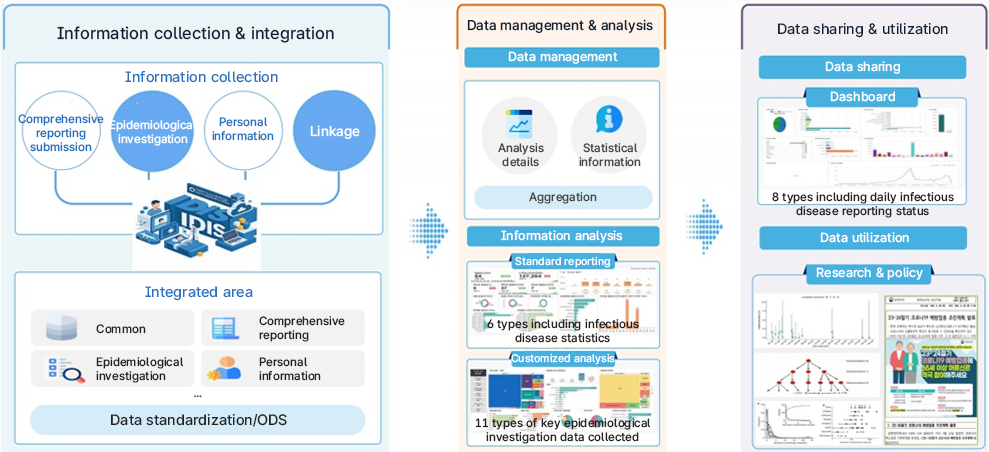
This image explains the flow of infectious disease data in three stages.
Stage 1: Information Collection & Integration (Left)
- Collected items: Comprehensive reporting, epidemiological investigation, personal information, linked information.
- The collected information is integrated into common areas such as comprehensive reporting, epidemiological investigations, and personal information.
- Data is managed through standardization and the ODS (Operational Data Store) system.
Stage 2: Data Management & Analysis (Center)
- Data management: Aggregated through detailed analysis and statistical information.
- Information analysis:
- Structured reports: 6 types of reports, including infectious disease statistics.
- Custom analysis: Provides 11 types of analysis based on key epidemiological investigation data.
Stage 3: Data Sharing & Utilization (Right)
- Data sharing: 8 types of visualizations are provided in dashboard format, including daily infectious disease reporting status.
- Data utilization: Reflected in research and policy, used in real-world applications like infectious disease prevention campaigns.
Summary Interpretation
Information is collected from various sources such as comprehensive reporting and epidemiological investigations, standardized and analyzed, and then provided in the form of dashboards and reports.
Ultimately, this data-driven infectious disease management system is utilized in research and policy making.
Stage 1: Information Collection & Integration (Left)
- Collected items: Comprehensive reporting, epidemiological investigation, personal information, linked information.
- The collected information is integrated into common areas such as comprehensive reporting, epidemiological investigations, and personal information.
- Data is managed through standardization and the ODS (Operational Data Store) system.
Stage 2: Data Management & Analysis (Center)
- Data management: Aggregated through detailed analysis and statistical information.
- Information analysis:
- Structured reports: 6 types of reports, including infectious disease statistics.
- Custom analysis: Provides 11 types of analysis based on key epidemiological investigation data.
Stage 3: Data Sharing & Utilization (Right)
- Data sharing: 8 types of visualizations are provided in dashboard format, including daily infectious disease reporting status.
- Data utilization: Reflected in research and policy, used in real-world applications like infectious disease prevention campaigns.
Summary Interpretation
Information is collected from various sources such as comprehensive reporting and epidemiological investigations, standardized and analyzed, and then provided in the form of dashboards and reports.
Ultimately, this data-driven infectious disease management system is utilized in research and policy making.