
Background
- In 2015, the World Health Organization (WHO) warned of an international health crisis related to antimicrobial resistance, and presented the “Global Action Plan on Antimicrobial Resistance,” strongly urging countries to prepare response measures and enhance international collaboration.
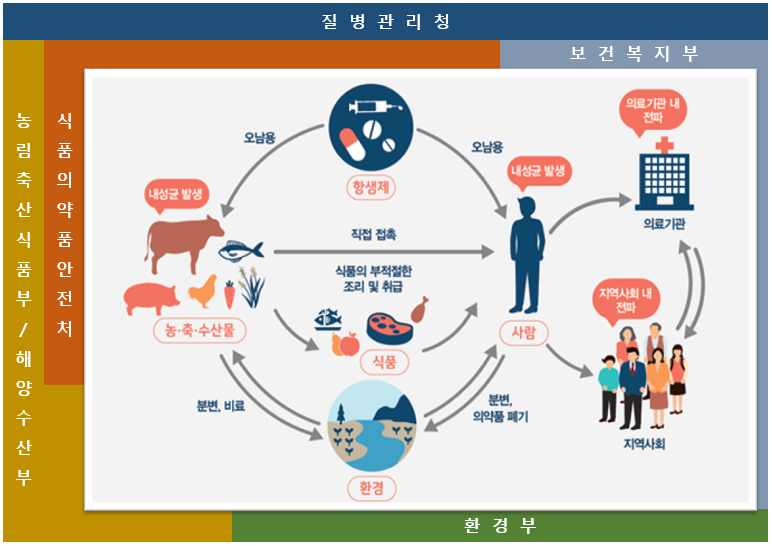
- Since 2016, South Korea has established and implemented a multi-ministerial* “National Antimicrobial Resistance Control Strategy” on a five-year cycle to address the issue of antimicrobial resistance. * Korea Disease Control and Prevention Agency (lead), Ministry of Health and Welfare, Ministry of Food and Drug Safety, Ministry of Agriculture, Food and Rural Affairs, Ministry of Environment, Ministry of Oceans and Fisheries
- Adoption of a political declaration* on antimicrobial resistance at the high-level meeting of the 79th UN General Assembly (September 26, 2024) * Securing future health security through present efforts: Calls for global, regional, and national efforts to address antimicrobial resistance
Legal basis
- Article 8-3 (Measures for Controlling Resistant Bacteria) and Article 8-4 (Cooperation in Business) of the Infectious Disease Control and Prevention Act
- Article 1-5 (Formulation of Measures for Controlling Resistant Bacteria) and Article 32 (Delegation of Authority and Entrustment of Affairs) of the Enforcement Decree of the same Act
Main Contents
- Currently implementing the “2nd National Action Plan on Antimicrobial Resistancen (2021-2025),” which consists of:
- ① Appropriate use of antibiotics, ② prevention of the spread of resistant bacteria, ③ strengthening of surveillance systems, ④ expansion of research and development, and ⑤ activation of a cooperative system for antimicrobial resistance management.
-
VisionAchieving sustainable health for the public by managing antibiotic resistance in humans, animals, and the environment
- Objectives
- Key Performance Indicators
- 1
Reduce antibiotic-resistant bacteria by using appropriate amounts and types of antibiotics only where necessary
- 1
[Humans] Reduction in antibiotic usage [Animals] Reduction in antibiotic sales
- 2
Suppress the spread of antibiotic-resistant bacteria through strengthened surveillance systems and active infection management
- 2
[Humans] Reduction in the number of blood isolates of 6 types of antibiotic-resistant bacteria [Animals] Decrease in antibiotic resistance rate of E. coli in livestock
- Key Areas
- Key Tasks
-
1
Appropriate use of antibiotics
- 1Antibiotic usage control program in healthcare institutions
- 2Development, dissemination, and education on guidelines for appropriate use of antibiotics
- 3Conducting evaluations of antibiotic appropriateness in healthcare institutions
- 4Appropriate use of antibiotics in the livestock and aquaculture sectors
- 5Prevention of the spread of resistant bacteria in the livestock and aquaculture sectors
-
2
Prevention of the spread of resistant bacteria
- 1Strengthening infection prevention management in healthcare institutions
- 2Expanding support for infection prevention management in healthcare institutions
- 3Strengthening measures to prevent the spread of resistant bacteria during patient transfers
- 4Prevention of the spread of resistant bacteria in the livestock and aquaculture sectors
-
3
Strengthening of surveillance systems
- 1Establishing a surveillance system for monitoring antibiotic usage in humans
- 2Strengthening the surveillance system for antibiotic-resistant bacteria in humans
- 3Expanding the management system for antibiotic residues in animals
- 4Strengthening the surveillance system for antibiotic-resistant bacteria in animals
- 5Establishing an integrated surveillance system
-
4
Expansion of research and development
- 1Conducting research on antibiotic-resistant bacteria from a One Health perspective
- 2Strengthening research for the appropriate use of antibiotics
- 3Strengthening the development of rapid diagnostic tools and treatments for antibiotic-resistant bacteria
-
5
Activating the antibiotic resistance management collaboration system
- 1Establishing a collaboration system among domestic ministries to address antibiotic resistance
- 2Strengthening international cooperation to address antibiotic resistance
[Implementation Strategy for the 2nd National Action Plan on Antimicrobial Resistance (2021-2025)]