컨텐츠 영역
Surveillance of Viral Infectious Disease Pathogens
Purpose of surveillance of viral infectious disease pathogens
- The goal is to detect viral outbreaks early to prevent the spread of infectious diseases. To this end, the Korea Centers for Disease Control and Prevention’s Division of Viral Diseases operates various virus surveillance systems in collaboration with local medical institutions and provincial health and environmental research institutes.
Infectious diseases subject to surveillance
- A total of 9 types of viral infectious diseases are monitored
- Class 3 infectious diseases (diseases that must be reported immediately upon occurrence): Japanese encephalitis, West Nile fever, tick-borne encephalitis
- Class 4 infectious diseases (infectious diseases monitored through sample surveillance): Norovirus, Group A rotavirus, enteric adenovirus, astrovirus, sapovirus, enterovirus (including hand, foot, and mouth disease)
Major surveillance systems
- EnterNet Korea (Waterborne and Foodborne Infectious Disease Pathogen Surveillance System): Analyzes outbreaks of acute diarrheal diseases caused by water or food.
- The target includes 5 types: Norovirus, Group A rotavirus, enteric adenovirus, astrovirus, and sapovirus, with 17 city and provincial health and environmental research institutes and 77 medical institutions participating.
- KESS (Surveillance system for enterovirus infections): Analyzes the outbreak patterns and dominant genotypes of enteroviruses that cause hand, foot, and mouth disease, aseptic meningitis, and herpetic angina in infants and young children.
- 17 city and provincial health and environmental research institutes and 83 participating medical institutions are involved.
- K VESS (Integrated Encephalitis Syndrome Pathogen Surveillance System): When suspected cases of Japanese encephalitis or tick-borne encephalitis occur, it tests for nine types of encephalitis-causing viruses to identify the cause.
- The target includes 9 types: Japanese encephalitis virus, tick-borne encephalitis virus, West Nile virus, dengue virus, Zika virus, varicella virus, adenovirus, measles virus, and enterovirus. This is a new initiative that started in 2024, currently involving 5 city and provincial health and environmental research institutes.
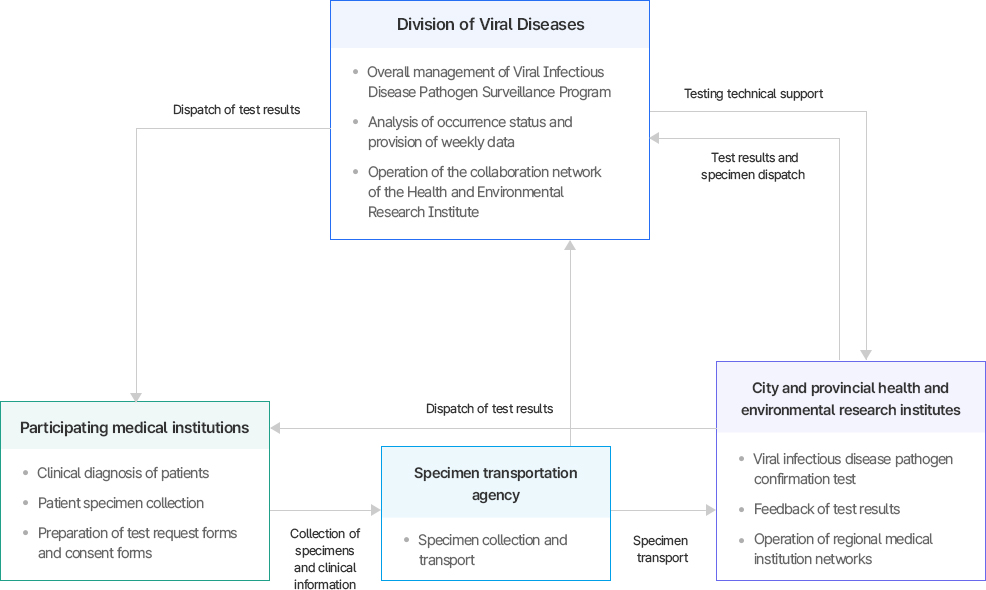
This image illustrates the system in which viral infectious disease pathogen testing is carried out and the results are shared.
Participating Medical Institutions
- Clinical diagnosis and specimen collection from patients.
- Completion of test request forms and consent forms.
- Receiving test results.
Specimen Transport Institutions
- Collects specimens and clinical information from participating medical institutions.
- Transports specimens to the provincial health and environment research institute or the virus analysis department.
Provincial Health and Environment Research Institutes
- Conducts tests to identify viral infectious disease pathogens.
- Provides test results back to participating medical institutions and manages local healthcare networks.
- Sends results to the virus analysis department.
Virus Analysis Department (Central)
- Oversees viral infectious disease pathogen testing programs.
- Analyzes the occurrence status and provides weekly data.
- Operates a collaborative network with the health and environment research institutes.
- Provides technical support and compiles and analyzes test results.
Summary of Information Flow
1. Patient diagnosis and specimen collection: Performed at participating medical institutions.
2. Specimen collection and transport: Delivered through specimen transport institutions to research institutes.
3. Testing: Provincial health and environment research institutes conduct pathogen testing and identification.
4. Central management: The virus analysis department oversees testing programs, compiles results, provides technical support, and supplies data.
5. Feedback: Test results and occurrence data are sent back to medical institutions and research institutes.
Summary Interpretation
Specimens and information are reported upward from participating medical institutions → transport institutions → provincial health and environment research institutes → virus analysis department,
and the test results and analysis data are fed back to be utilized in field diagnosis and policy management.
Participating Medical Institutions
- Clinical diagnosis and specimen collection from patients.
- Completion of test request forms and consent forms.
- Receiving test results.
Specimen Transport Institutions
- Collects specimens and clinical information from participating medical institutions.
- Transports specimens to the provincial health and environment research institute or the virus analysis department.
Provincial Health and Environment Research Institutes
- Conducts tests to identify viral infectious disease pathogens.
- Provides test results back to participating medical institutions and manages local healthcare networks.
- Sends results to the virus analysis department.
Virus Analysis Department (Central)
- Oversees viral infectious disease pathogen testing programs.
- Analyzes the occurrence status and provides weekly data.
- Operates a collaborative network with the health and environment research institutes.
- Provides technical support and compiles and analyzes test results.
Summary of Information Flow
1. Patient diagnosis and specimen collection: Performed at participating medical institutions.
2. Specimen collection and transport: Delivered through specimen transport institutions to research institutes.
3. Testing: Provincial health and environment research institutes conduct pathogen testing and identification.
4. Central management: The virus analysis department oversees testing programs, compiles results, provides technical support, and supplies data.
5. Feedback: Test results and occurrence data are sent back to medical institutions and research institutes.
Summary Interpretation
Specimens and information are reported upward from participating medical institutions → transport institutions → provincial health and environment research institutes → virus analysis department,
and the test results and analysis data are fed back to be utilized in field diagnosis and policy management.
Disclosure and utilization of surveillance results
- The data collected through surveillance is updated weekly on the Disease Control and Prevention Agency's website under the Infectious Disease Portal → Infectious Disease News → Publications and Newsletters → Laboratory Newsletter.
- This laboratory newsletter summarizes the latest results of each surveillance system and is used as a fundamental resource for establishing infectious disease response policies. In addition, medical institutions actively utilize this data to understand the regional epidemic situation and take appropriate treatment and prevention measures, enabling healthcare professionals to respond effectively in the field.