Standard Laboratory Operations
Overview
- Standardized laboratory operations to improve the diagnostic accuracy of bacterial infections and laboratory reliability
- As a designated national standard laboratory through national certification, it operates a diagnostic analysis and proficiency evaluation system for recognized infectious diseases, and - in addition, through the operation of standardized laboratories for bacterial infections, it conducts quality management of laboratories, including the dissemination of standard testing methods, laboratory training, proficiency evaluation, and technical support.
Status of the operation of the national standard laboratory for bacterial infectious diseases
| Target Infectious Diseases | Scope of Recognition |
|---|---|
| Invasive respiratory bacteria (Pneumococcus, Haemophilus influenzae type b, Meningococcus) |
Conducting tests |
| Typhus fever | Conducting tests |
| Carbapenem-resistant Enterobacteriaceae (CRE) | Conducting tests and proficiency evaluation operations |
Operation of International Molecular Epidemiology Network Cooperation
Overview
- Utilized to identify relationships and transmission routes between domestic and international infectious disease outbreak pathogens through genome-based molecular epidemiological analysis
- Participating in the PulseNet international network, which connects over 83 countries, to secure a global collaborative response framework through pathogen analysis and genome data sharing
Target pathogens
Cholera, shigellosis, Salmonella, pathogenic Escherichia coli, Vibrio vulnificus, Clostridium perfringens, Staphylococcus aureus, antibiotic-resistant bacteria, and other bacterial pathogens
Analysis items
: Whole genome sequencing (WGS), pulsed-field gel electrophoresis (PFGE), etc.
Operational items
- Genetic association analysis of pathogens through genome-based molecular epidemiological analysis using WGS, PFGE, etc.
- Identifying the connections between outbreak clusters, determining whether they are imported from abroad, and tracking mutations to understand the characteristics of the outbreak
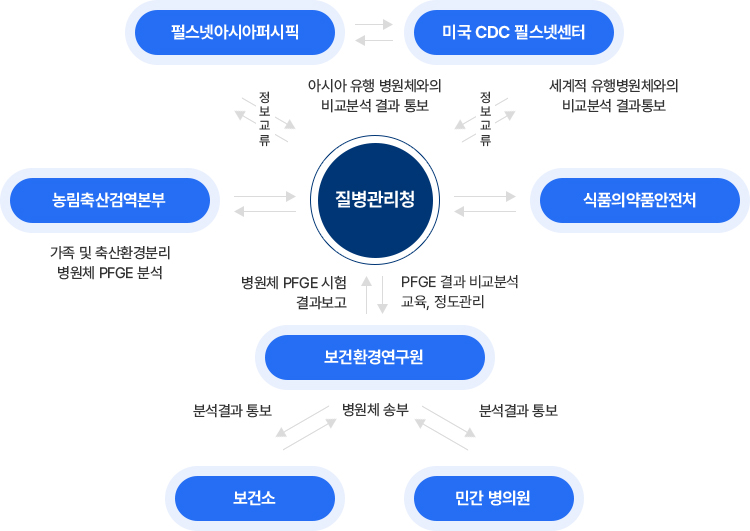
Analysis system
이 이미지는 질병관리청을 중심으로 국내외 기관들이 연계되어 감염병 병원체를 분석하고 결과를 공유하는 체계를 나타낸다. ■ 중앙 기관: 질병관리청 - 국내외 분석 기관과 정보를 교류하며, PFGE(펄스필드겔전기영동) 결과를 비교·분석하고 교육·정도관리 기능을 수행. ■ 국내 연계 기관 1. 보건환경연구원 - 민간 병의원과 보건소에서 병원체를 수부받아 분석. - 분석 결과를 질병관리청에 보고. 2. 농림축산검역본부 - 가축 및 축산환경에서 분리된 병원체를 PFGE 기법으로 분석. - 분석 결과를 질병관리청에 보고. 3. 식품의약품안전처 - 식품 관련 병원체 분석 결과를 질병관리청과 공유. ■ 국제 연계 기관 1. 필스넷아시아퍼시픽(PulseNet Asia Pacific) - 아시아 지역 병원체 분석 결과를 질병관리청에 제공. 2. 미국 CDC 필스넷센터(PulseNet CDC) - 세계적 유행 병원체와의 비교 분석 결과를 공유. ■ 정보 흐름 - 보건소·민간 병의원 → 보건환경연구원 → 질병관리청으로 병원체와 분석 결과가 상향 보고됨. - 질병관리청 ↔ 농림축산검역본부·식약처·국제 네트워크(아시아·미국 CDC) 간에는 분석 결과와 비교 자료가 환류되어 공유됨. ■ 종합 해석 이 체계는 질병관리청을 중심으로 국내(보건환경연구원·농림축산검역본부·식약처)와 국제 네트워크(아시아·미국 CDC)가 협력하여 병원체를 분석하고, 그 결과를 상호 보완