컨텐츠 영역
Operation of Biological Terrorism Response Laboratory Network
Overview
- In the event of a suspected biological terrorism situation, an operational laboratory network is in place to efficiently control and prevent the spread of pathogens through rapid and accurate pathogen detection and diagnostic testing by connecting public health diagnostic laboratories and medical institution testing laboratories.
Domestic and International Laboratory Networks
Domestic Biological Terrorism Response Laboratory Network
- - Since 2002, it has been established and operated to effectively respond to suspected biological terrorism infectious disease patients and environmental samples through pathogen surveillance and rapid testing and analysis of causal pathogens.
- Routine inspection and maintenance of the nationwide laboratory network operation system, dissemination of diagnostic testing methods for high-risk pathogens, training and proficiency evaluation, environmental surveillance in areas of biological terrorism concern, and on-site response.
International Laboratory Network
- Since 2013, it has participated in the international laboratory network organized by the U.S. CDC as a reference laboratory.
- Sharing diagnostic testing methods and the latest information on high-risk pathogens such as biological terrorism pathogens, and participating in proficiency evaluation.
Project Details
Domestic Operation of the Domestic Biological Terrorism Response Laboratory Network
- Inspection of Grade B laboratories in the laboratory network for preparedness against domestic occurrences of bioterrorism agents such as anthrax
- Distribution of diagnostic reagents for biological terrorism infectious disease pathogens
- Training and proficiency evaluation* for personnel responsible for pathogen diagnosis and detection testing Culture testing of high-risk pathogens and genetic detection testing of unidentified environmental samples
International Continuation of participation in Laboratory Network
- Securing the latest diagnostic testing methods and reagents for biological terrorism pathogens
- Participation in proficiency evaluation for detection and testing of biological terrorism pathogens
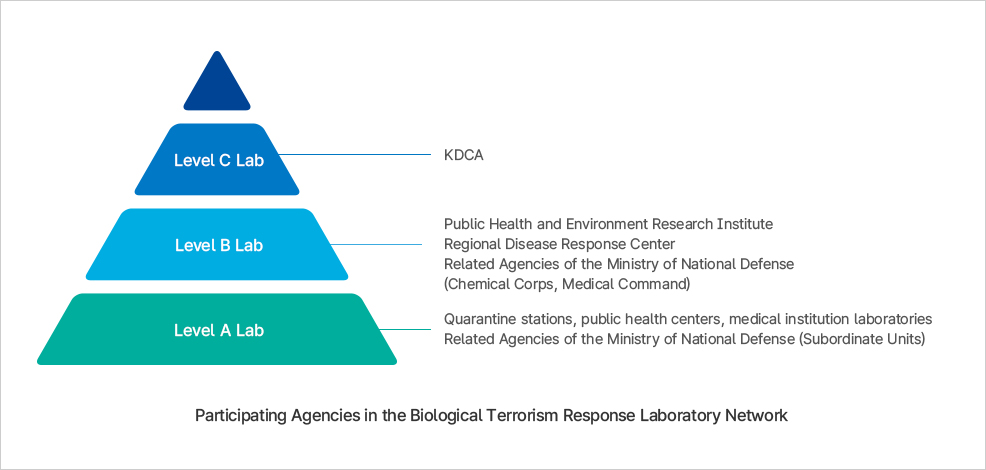
This image is a pyramid diagram that categorizes the institutions participating in the biological terrorism response laboratory network into different levels.
- Level C Lab: Korea Disease Control and Prevention Agency (KDCA)
- Level B Lab: Public Health and Environment Research Institute, Regional Disease Control Centers, Ministry of National Defense related institutions (Chemical Corps, Medical Corps)
- Level A Lab: Quarantine Stations, Public Health Centers, Medical Institution Laboratories, Ministry of National Defense related institutions (Subordinate Units)
Meaning: The higher the level, the more centralized and specialized the role, while lower levels are responsible for regional and on-site responses.
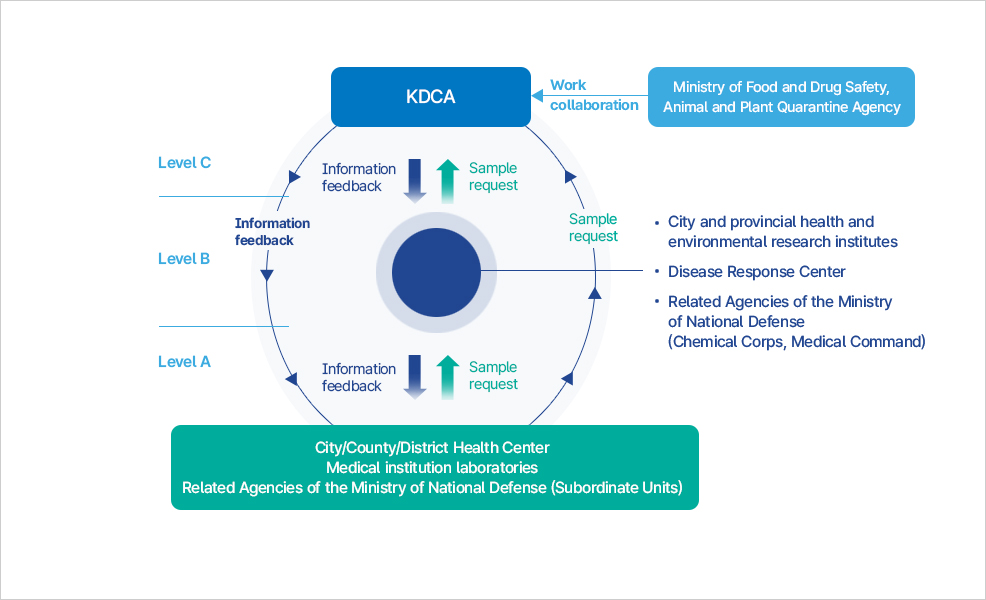
This diagram represents the linkage system of the biological terrorism response laboratory network.
- Level C: The Korea Disease Control and Prevention Agency (KDCA) is the highest-level institution, cooperating with the Ministry of Food and Drug Safety and the Animal and Plant Quarantine Agency.
- Level B: This includes the Public Health and Environment Research Institutes of the provinces, Disease Control Centers, and Ministry of National Defense-related institutions (Chemical Corps, Medical Corps). They perform information exchange and specimen referral with the KDCA and lower-level institutions.
- Level A: This includes the Public Health Centers of cities, counties, and districts, medical institution laboratories, and Ministry of National Defense-related institutions (subordinate units). They refer specimens collected in the region to higher-level institutions and share information.
Information Flow: Information and specimens collected from Level A institutions are transmitted to Level B and the KDCA, and higher-level institutions provide feedback with results and information to lower-level institutions.