컨텐츠 영역
Approval for development and experimentation using living modified organisms for testing and research purposes
To develop or experiment with living modified organisms with a high potential for harm, prior approval from the Director of the Disease Control Agency is required.
Subjects requiring approval for development and experimentation
- Where microorganisms are used that are not specified down to the species level, and for which the pathogenicity to humans has not been established
- Where genes with the ability to produce proteolytic toxins that have a lethal dose of less than 100 ng per 50% of body weight per 1 kg of vertebrates are used
- Integrated Announcement of the Living Modified Organisms Act [Appendix 2-1] Botulinum toxins (types A, B, C, D, E, F), tetanus toxin, dysenteric neurotoxin, diphtheria toxin, etc.
- Where antibiotic resistance genes are deliberately transmitted to microorganisms in a manner that does not occur naturally
- Integrated Announcement of the Living Modified Organisms Act [Appendix 2-2]Antibiotic resistance genes exempt from approval
: living modified microorganisms developed using host-vector systems that confer resistance to ampicillin, chloramphenicol, hygromycin, kanamycin, neomycin, puromycin, spectinomycin, streptomycin, tetracycline, or zeocin
- Integrated Announcement of the Living Modified Organisms Act [Appendix 2-2]Antibiotic resistance genes exempt from approval
- In cases where the genes of pathogenic microorganisms that require national management for public health are directly utilized or synthesized for use.
- Unified Notice for the Act on the Transboundary Movement, Etc. of Living Modified Organisms [Annex Table 2-3] [View table]
- Imports of commercially available living modified animal and plant cell lines must be reported to the Ministry of Science and ICT.
- Even where only cultivation (propagation) is conducted using living modified organisms that have received import approval, development and experiment approval is required.
Development and experiment approval processing procedure
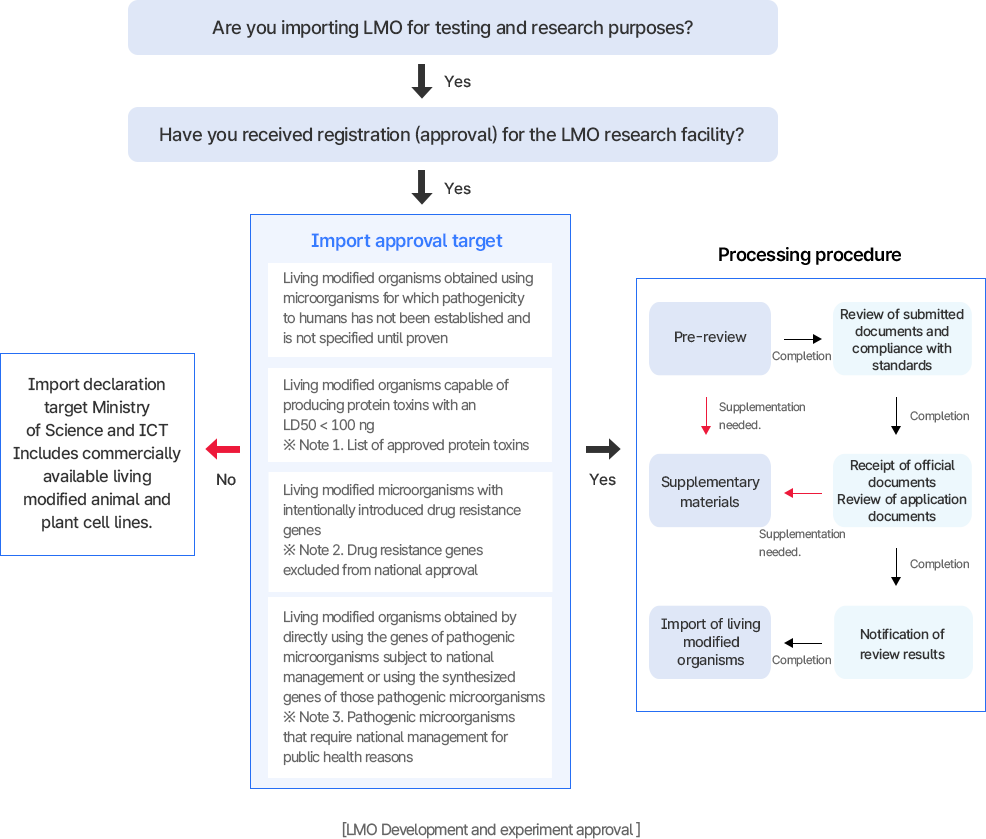
This image is a flowchart illustrating the step-by-step approval procedure for the development and experimentation of genetically modified organisms (LMOs) for testing and research purposes.
- Initial Check: Confirmation of whether development or experimentation is conducted → Confirmation of whether the research facility has been reported (or approved).
- Items Requiring Approval:
- Development or experimentation using microorganisms with unclear pathogenicity
- Development or experimentation using genes capable of producing protein toxins (LD₅₀ < 100 ng)
- Development or experimentation involving the intentional introduction of antimicrobial resistance genes
- Development or experimentation using pathogenic microorganisms requiring national control
- Processing Procedure:
- Preliminary review: Review of submitted documents and compliance with applicable standards
- Document supplementation: Requests for additional information or corrections, if necessary
- Review of officially submitted application documents
- Notification of review results → Authorization to proceed with the development and experimentation of genetically modified organisms
Meaning: The development and experimentation of LMOs are subject to approval based on risk factors such as pathogenicity and toxin or gene characteristics. Final approval is granted after preliminary review and any required document supplementation.
Documents to submit
-
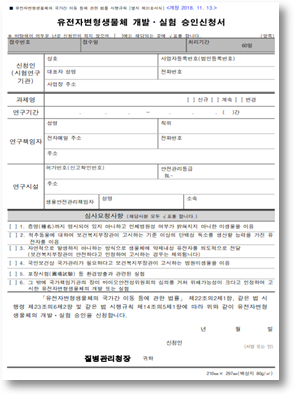
- Application for approval of development and experimentation of living modified organisms
- Plan for the use of living modified organisms for testing and research purposes
- Scope of submission for risk assessment data of development and experimentation
- Supporting documents for submitted materials
- Guide to the national approval system for living modified organisms for testing and research purposes
Processing deadline
(If there is a period for supplementation of materials, the supplementation period is not included in the processing deadline.)
- Within 60 days.
Changes to development and experimentation approval details
- Scope of change notification and change approval
Change notification, Change approval Table Change notification Change approval If it falls under “minor matters” as stated in Article 8 (3) of the LMO Act, it is subject to change notification. - Change in quantity of non-microbial LMO imported (volume or mass) to less than 1/100 of the original amount
- Change of importer’s name, address, or contact information
Matters that do not fall under “minor matters” - Change application procedure
- Application documents: Attach the submitted documents to the change application or report for processing
- How to submit: Electronic document or email (including official documents)
- Where to submit: Biological Safety Assessment Division, Centers for Disease Control and Prevention
- Processing period (If there is a document supplementation period, the supplementation period is not included in the processing deadline.)
- Change approval: Within 60 days
- Change notification: Within 10 days