컨텐츠 영역
Status of Radiation Workers
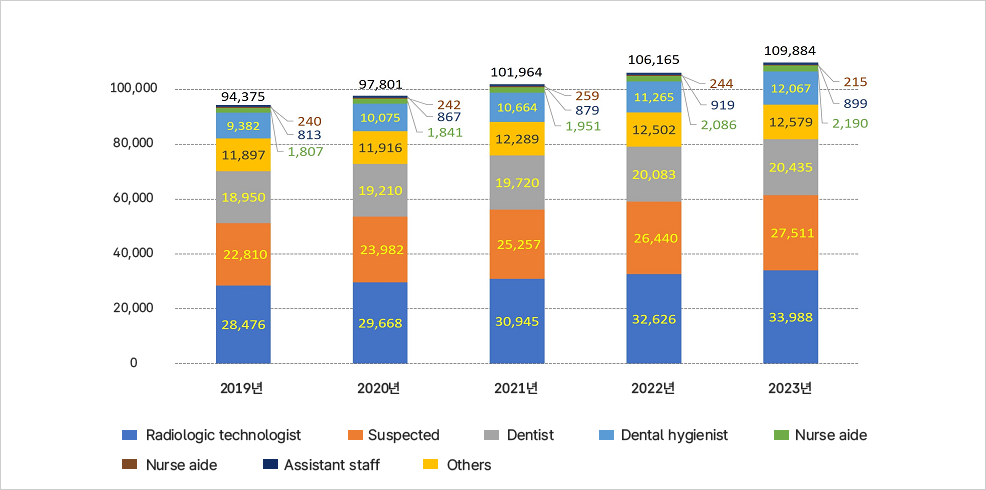
- The number of radiation workers increased approximately 8.69-fold, from 12,652 in 1996 to 109,884 in 2023.
- As of 2023, the average per capita radiation exposure dose for radiation workers is on a downward trend at 0.37 mSv. However, enhanced safety management is necessary to protect radiation workers from the radiation risks that may arise when handling medical radiation. Average exposure dose: 0.45 mSv ('19)→0.40 mSv ('20)→0.38 mSv ('21)→0.38 mSv ('22) →0.37 mSv ('23)
Status of Radiation Workers
This graph shows changes in the number of radiation-related workers by occupation from 2019 to 2023.
- Total workforce: Steadily increased from 94,375 in 2019 to 109,884 in 2023.
- Radiologic technologists: 28,476 in 2019 → 33,988 in 2023.
- Physicians: Increased significantly from 22,810 in 2019 to 27,511 in 2023.
- Dentists: 18,950 in 2019 → 20,435 in 2023.
- Dental hygienists: 11,897 in 2019 → 12,579 in 2023.
- Nurses: 9,382 in 2019 → 12,067 in 2023.
- Nurse aides: 1,807 in 2019 → 2,190 in 2023.
- Support staff: 813 in 2019 → 899 in 2023.
- Others: Slightly decreased from 240 in 2019 to 215 in 2023.
Meaning/Interpretation: The total number of radiation-related workers has increased every year, with particularly notable growth among physicians, radiologic technologists, and nurses, while the “other” category shows a declining trend.
※ What is a radiation worker?
This is a person whose main place of work has a diagnostic radiation-generating device installed and who is engaged in radiation-related tasks such as the management, operation, and manipulation of the diagnostic radiation-generating device.
Article 2 (Definitions) of the "Rules on the Safety Management of Diagnostic Radiation-generating Devices"