컨텐츠 영역
HIV (Human Immunodeficiency Virus)
An abbreviation of “Human Immunodeficiency Virus,” HIV is the pathogen that causes acquired immunodeficiency syndrome.
HIV exists in all bodily fluids of an infected person, with particularly high concentrations found in blood, semen, vaginal secretions, and breast milk.
AIDS (Acquired Immune Deficiency Syndrome)
AIDS is an abbreviation of “Acquired Immune Deficiency Syndrome,” and its Korean name is "후천성면역결핍증." “Acquired” is a term that contrasts with “congenital,” meaning it is not hereditary, and “immune deficiency syndrome” refers to a condition in which immune cells responsible for the body’s defense functions are destroyed, leading to a diminished immune function.
HIV-infected Person
A general term referring to a person infected with HIV, that is, someone who carries HIV in their body.
AIDS Patient
This refers to a person who has been diagnosed with AIDS based on the presence of specific opportunistic infections that occur when HIV invades the body, destroys immune cells, and weakens immune function.
The criteria for diagnosing an AIDS patient is when the number of immune cells (CD4+ T cells) in the infected person is below 200 cells/㎣ or when opportunistic infections corresponding to "AIDS-defining illnesses" such as Pneumocystis pneumonia occur.
Clinical Latency Period
The clinical latency period refers to the time it takes from infection to the onset of disease, specifically the duration until symptoms appear after HIV has invaded the body.
The clinical latency period varies from person to person, and is generally known to be as short as 6 months to as long as over 15 years. In other words, it is influenced by the individual’s constitution, nutritional status, and the nature of the virus, so even after infection, there are many cases where no significant symptoms appear for over 10 years.
Course of HIV Infection
The clinical course of HIV infection progresses gradually, and the changes in the number of immune cells and the concentration of the virus in the blood over time after infection are illustrated in the figure below.
The course of HIV infection goes through three stages: acute symptoms, clinical asymptomatic phase, and symptomatic phase.
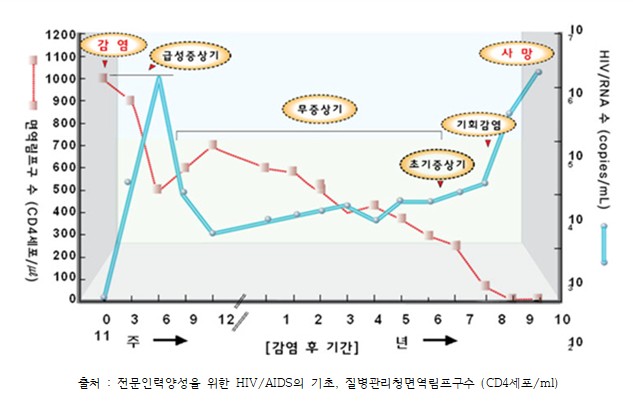
- Immediately after infection: HIV RNA levels increase sharply, causing the viral load to become very high.
- Acute symptomatic stage: Within a few weeks after infection, the virus rapidly increases, and the immune cell count decreases drastically. Early symptoms such as fever and swollen lymph nodes may appear during this stage.
- Asymptomatic stage: The immune system temporarily suppresses the virus, causing HIV RNA levels to decrease slightly and stabilize at a certain level. However, the immune cell count (CD4) gradually decreases, and the asymptomatic phase continues for a long period.
- Opportunistic infection and symptomatic stage: When the immune cell count drops below 200/㎣, opportunistic infections such as pneumonia, tuberculosis, and candidiasis may appear.
- End stage (fatal stage): The immune cell count becomes extremely low, and the viral load rises again. If untreated, this stage can lead to death.
In summary, HIV infection follows a three-stage progression: an acute symptomatic stage immediately after infection, followed by a long asymptomatic stage, and eventually leading to opportunistic infections and symptom development due to immune suppression.
Acute symptom phase (3 to 4 weeks after infection)
30-50% of infected patients exhibit nonspecific symptoms such as fever, muscle pain, loss of appetite, nausea, abdominal pain, and skin rashes. Symptoms generally appear about one month after infection and last for approximately 10 to 15 days.
Clinical asymptomatic phase (before the onset of AIDS after infection)
After the symptoms of the acute infection phase subside, individuals can typically lead a normal life without specific symptoms for an average of about 8 to 10 years. The duration of this period varies among individuals; however, there is still a risk of transmission to others even in the absence of symptoms.
Symptomatic phase
After the asymptomatic phase, the early symptom phase presents several prodromal symptoms (such as weight loss, fatigue, loss of appetite, and insomnia). Subsequently, a late symptomatic phase occurs, where opportunistic infections or malignancies appear depending on the number of immune cells (CD4+ T cells).
Treatment for Infected Person
HIV treatment involves antiretroviral therapy (ART), which effectively reduces the amount of HIV in the body, helping to maintain the health of the infected person and prevent transmission to others. Although there is currently no cure, most individuals can achieve viral control within six months by adhering to prescribed medications through treatment.
The Joint United Nations Programme on HIV/AIDS (UNAIDS) has declared that individuals with HIV who take their medications properly and have an undetectable viral load do not transmit the virus through sexual contact (U=U; Undetectable = Untransmittable). This declaration has been adopted by all countries, including the United States and the United Kingdom.