
Project Overview
- Collection of emergency room-based injury data whose purpose is to identify injury mechanisms and risk factors and to produce statistics
- Establishment and evaluation of injury prevention and management policies using injury data
Survey Target and Implementation System
- Survey Target: All injury patients who visited the participating hospitals (23) of the In-depth Survey of Emergency Department Injury Patients ※ Patients whose primary and other diagnosis codes fall under S00-T79 (Injury, poisoning, and other specific consequences of external causes) of the International Classification of Diseases
- Survey Type: Data is collected by dedicated coordinators assigned to each hospital.
- Number of participating hospitals: 23
- Survey Method: Use of medical records and implementation of interview surveys
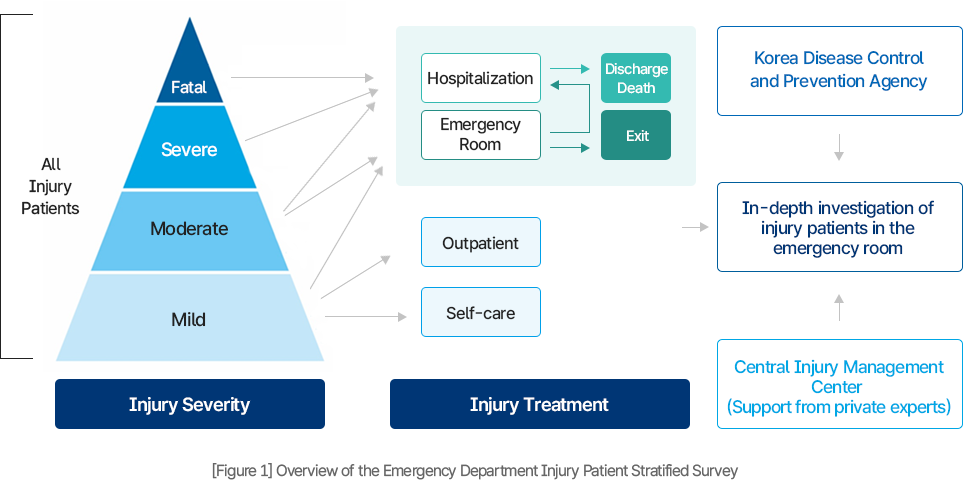
이 그림은 응급실 손상환자 심층조사의 개요를 보여준다.
- 손상 중증도: 경증, 중등도, 중증, 치명적으로 구분된다.
- 손상 치료:
- 경증과 중등도는 주로 외래 또는 자가치료를 받는다.
- 중증과 치명적 손상은 응급실과 입원 치료로 이어지며, 이후 퇴원, 사망, 또는 퇴실 경로를 거친다.
- 감시체계:
- 응급실 손상환자 심층조사는 질병관리청이 주관하며, 중앙손상관리센터가 민간 전문가의 지원을 통해 운영한다.
의미: 전체 손상환자를 중증도에 따라 구분하고, 치료 경로와 연계된 응급실 심층조사를 통해 국가 차원의 손상 발생 현황과 원인을 체계적으로 파악한다는 점을 보여준다.
Main Survey Content
- Consists of a total of 118 questions
- 60 common items: Demographic characteristics, injury characteristics, treatment outcomes, etc.
- 58 in-depth items: Composed of 4 in-depth domains
- Transportation accidents: Accident mechanism at the time of occurrence, medication use, whether protective equipment was worn, etc. (16 items)
- Head/Spine: Presence of head/spine injury, intervention procedures, severity by injury site (AIS [Abbreviated Injury Scale]), etc. (6 items)
- Suicide/Poisoning/Falls: Reasons for self-discharge of suicide patients, amount of toxic substance, etc. (13 items)
- Pediatric/Adolescent injuries: Whether a guardian witnessed the event, type of violence, classification as self-harm/suicide attempt, reasons for poisoning, etc. (23 items)
Data Quality Control and Analysis
- Implementation of annual surveyor training and quality control meetings (3 times a year)
- Verification of data fidelity, such as duplicate data and missing required items
- Analysis of rates of unknown and missing values, reclassification of “other” items, and analysis of the relationship between survey questions
Participating Hospital Injury Patient DB
-
1st VerificationIn-depth Survey of Emergency Department Injury Patients Data Registration System (http://is.cdc.go.kr)Data fidelity analysis
- Check for duplicate data entry
- Check for missing required items
-
2nd VerificationQuality control using statistical program (SAS)In-depth analysis
- Analysis of rates of unknown and missing values
- Reclassification of “other” items
- Relationship between survey questions
-
3rd VerificationFeedback of in-depth quality control results to participating hospitalsError DB correction and quality control
- Request participating hospitals for quality control
- Confirmation of quality control results and re-request
- Repeat the quality control process twice
Establishment of the In-depth Survey of Emergency Department Injury Patients DB
[Figure 2] Quality Management Process of the Emergency Department Injury In-Depth Survey
Utilization and Policy Contribution
- Securing real-time injury surveillance data, including the status of injury patient occurrence in the emergency room and major causes
- Supporting the establishment of prevention policies by analyzing the characteristics of emergency room visits by age and injury type
- Utilizing data for early identification of high-risk injury groups and prevention strategies
- Providing data for community injury prevention projects and the improvement of laws and infrastructure