컨텐츠 영역
Project Overview
- A nationally approved statistics project conducted to provide basic data necessary for the establishment and evaluation of injury prevention and management policies by identifying factors related to the occurrence of severe injuries, mass casualties, and resulting disabilities and deaths
Survey Target and Implementation System
Target
A complete survey of severe injury and mass casualty patients transported to the emergency room via 119 emergency medical services
- Severe trauma: Among trauma patients due to transportation accidents, falls, slips, etc
- Those with an ISS [injury severity score] of 16 or higher, calculated through a medical record investigation
- Those who experienced pre-hospital cardiac arrest or pre-hospital death (death upon arrival at the emergency room)
- Non-traumatic severe injury: Patients with injuries from non-traumatic mechanisms such as poisoning, burns, drowning, sexual assault, suffocation, chemical substances, natural disasters, temperature-related injuries, etc., who have an abnormal trauma index
- Mass casualty: Cases where 6 or more patients were transported with the same disaster number on the ambulance run sheet
Survey Method
With the cooperation of the medical institutions to which severe trauma and mass casualty patients were transported, specialized surveyors visit these aforementioned medical institutions to review medical records and conduct the survey according to the survey form.
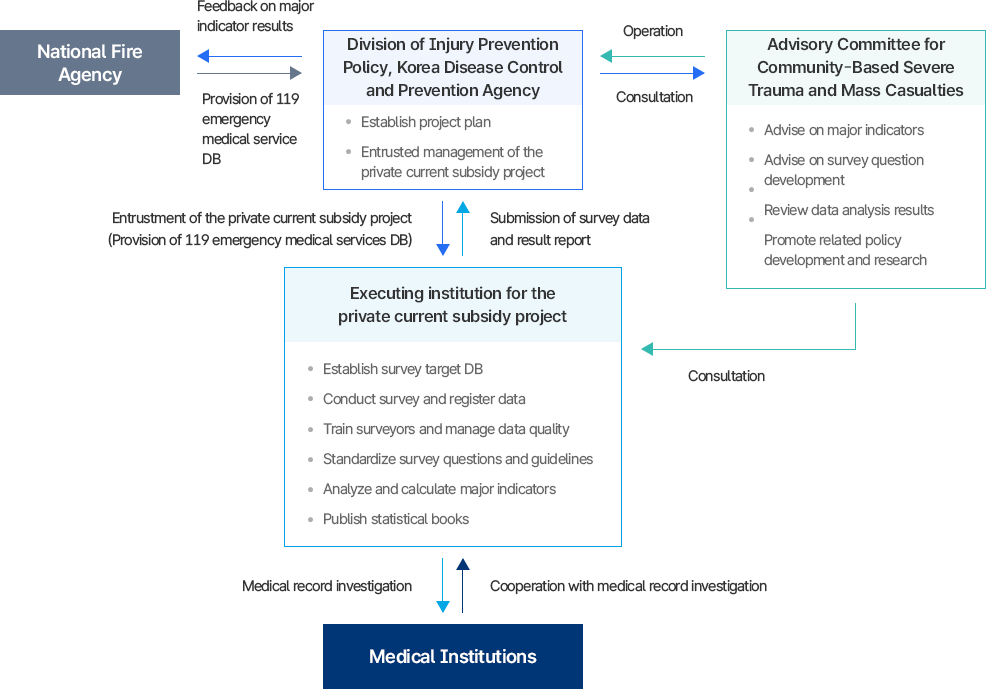
This diagram illustrates the investigation and operational framework for injury prevention policies.
- National Fire Agency: Provides the 119 emergency medical services (EMS) database to the Korea Disease Control and Prevention Agency (KDCA) and receives feedback on key indicator results.
- Injury Prevention Policy Division, Korea Disease Control and Prevention Agency: Responsible for establishing project plans and managing the outsourcing of private operating subsidy projects.
- Implementing Organizations for Private Operating Subsidy Projects:
- Establishment of survey target databases and conduct of surveys
- Training of surveyors and quality control of data
- Standardization of survey questionnaires and analysis of key indicators
- Publication of statistical reports
- Medical Institutions: Cooperate in medical record reviews and provide relevant data.
- Community-based Advisory Committees on Severe Trauma and Mass Casualty Incidents: Play roles in developing key indicators and survey questionnaires, reviewing data analyses, and supporting policy-making and research.
Meaning: This illustrates a collaborative structure in which the National Fire Agency, KDCA, medical institutions, private organizations, and advisory committees work together to scientifically formulate and evaluate injury prevention policies.
Survey Items
- General information, demographic and sociological information, injury information, initial treatment information, progress during treatment, post-hospitalization outcomes, disability and rehabilitation information, secondary transport hospital information, and death information.
Utilization and Policy Contribution
- Disclosure of statistical books and raw data through linkage with KOSIS [Korean Statistical Information Service] and the National Injury Information Portal kdca.go.kr/injury
- Production and provision of regional injury-related statistics
- Provision of basic data for preparing injury prevention and management programs
- Calculation of internationally comparable health indicators