컨텐츠 영역
Standardization of Diagnostic Tests for Chronic Diseases
Purpose
- Inaccurate diagnostic tests can cause problems such as loss of treatment opportunities, increased national medical costs, and reduced reliability of national statistical indicators.
- Establishment and operation of a standardization system to improve the accuracy of major diagnostic tests for chronic diseases Diabetes (glycated hemoglobin, glucose), kidney disease (creatinine), dyslipidemia (total cholesterol, triglycerides, HDL [high-density lipoprotein] & LDL [low-density lipoprotein] cholesterol)
Implementation System
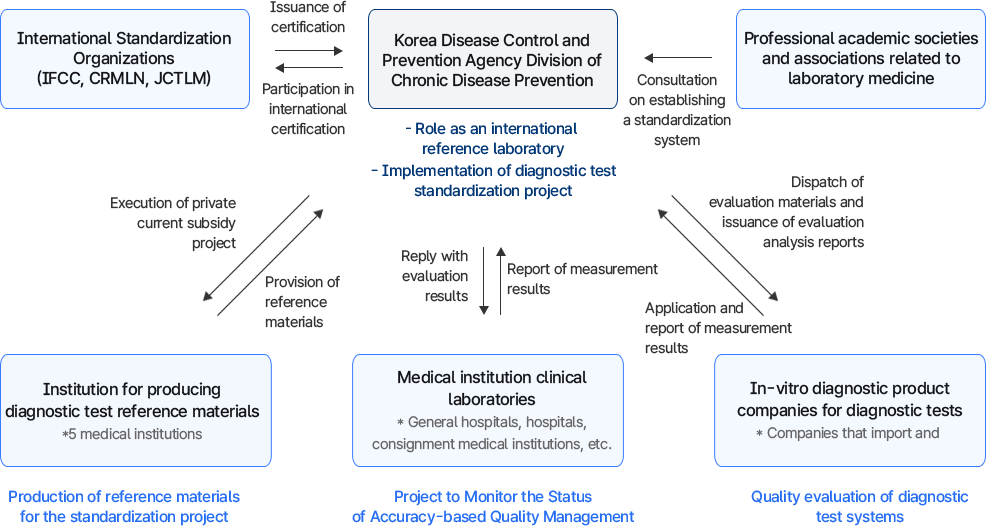
This image is a schematic diagram illustrating the implementation framework of the diagnostic testing standardization program.
- International Standardization Organizations (IFCC, CRMLN, JCTLM): Issuance of certificates and participation in international accreditation.
- Korea Disease Control and Prevention Agency (Division of Chronic Disease Prevention): Implementation of the diagnostic laboratory role standardization project and support for building a standardization framework.
- Professional academic societies and associations related to laboratory medicine: Provision of advisory support on standardization.
- Producers of diagnostic reference materials (five medical institutions): Production of reference materials for use in the standardization program.
- Clinical laboratories in medical institutions (general hospitals, university hospitals, contract testing institutions, etc.): Reporting of measurement results and participation in accuracy-based quality control monitoring programs.
- Manufacturers and importers of diagnostic reagents and equipment: Conducting quality assessments of diagnostic testing systems.
- Operational process: Reporting of measurement results → distribution and analysis of evaluation materials → feedback of evaluation results → issuance of certification.
Meaning: This illustrates the process by which international organizations, government agencies, academic societies, medical institutions, and companies collaborate to ensure the quality and accuracy of diagnostic testing systems and to establish a reliable, standardized testing framework.
Project Details
▲Operation of a national reference laboratory, ▲production of diagnostic test reference materials, and ▲implementation of diagnostic test standardization projects for the standardization of diagnostic tests.
- (Operation of a national reference laboratory) Operation of a national reference laboratory for laboratory medicine that meets international standardization requirements, including establishing standard testing methods for diagnostic test items and obtaining international certificati
- (Production of diagnostic test reference materials) Establishment of a system for producing the reference materials needed for the diagnostic test standardization project Consignment production through a diagnostic testing institution capable of large-scale blood supply and verification of reference materials
- (Diagnostic test standardization project)
| Project Name | Details | Target | Schedule |
|---|---|---|---|
| Project to Monitor the Status of Quality Management in Diagnostic Testing Institutions | Evaluation of the accuracy of diagnostic testing institutions, and preparation of the current status of quality management and basic data | Diagnostic testing institutions | Twice a year |
| Project for Quality Evaluation of Diagnostic Test Systems | Supply of high-quality in-vitro diagnostic products by analyzing accuracy, precision, total error, linearity, etc. | In-vitro diagnostic product companies | Twice a year |
| Measurement of reference values for reference materials | Measurement of reference values for reference materials used in diagnostic test quality management | Reference materials used for quality control | Always |